The Government Typo That Taught America Turkeys Want to Die
The Thing You Probably Learned in School That Isn't Real
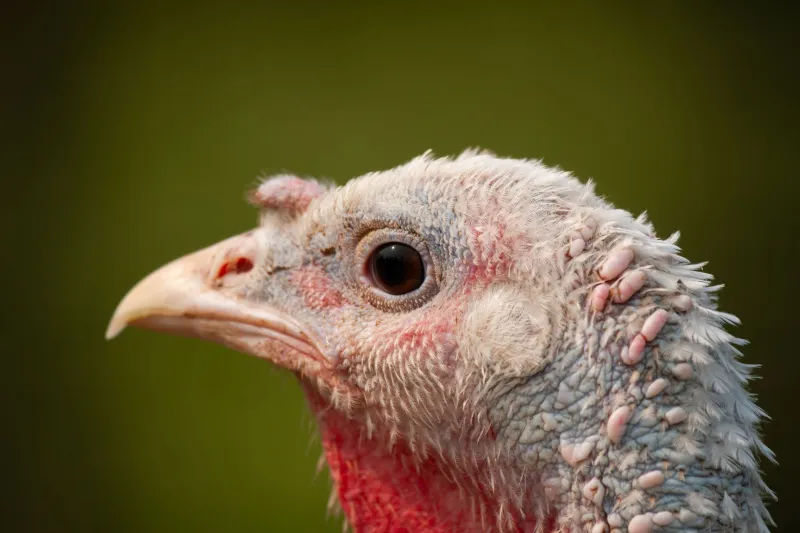
Ask almost any American adult about turkeys, and at some point the drowning thing comes up. You know the one. Turkeys are so stupid, the story goes, that they'll tilt their heads back to look at rain, forget to close their mouths, and drown standing in an open field. It gets trotted out every November as a fun Thanksgiving fact, repeated by elementary school teachers, cited in wildlife trivia segments, and used as the punchline of about ten thousand jokes about the intelligence of large birds.
It is also, in any meaningful sense, not true.
Wild turkeys have survived on this continent for millions of years. Domesticated turkeys, while genuinely not the sharpest animals on the farm, are not in the habit of drowning themselves in rainstorms. The behavior described in the myth — sustained, fatal, upward staring in precipitation — has not been documented in any peer-reviewed ornithological study. Farmers who work with turkeys daily will tell you it doesn't happen.
So where did everyone learn it?
The answer involves a government report, a careless transcription, and a remarkable demonstration of how official-looking errors become permanent fixtures of American folk knowledge.
The Document at Ground Zero
In 1954, the United States Department of Agriculture published a routine livestock management bulletin — the kind of dense, practical document that agricultural extension offices distributed to farmers and that almost nobody outside that world ever read. It covered feeding practices, disease prevention, housing standards, and behavioral notes on various domesticated bird species.
 Photo: United States Department of Agriculture, via woocoloring.com
Somewhere in the section on turkey husbandry, the document included a note about a genuine neurological condition called tetanic torticollar spasms — a real disorder, documented in some young turkeys, that causes involuntary upward head movements. Young birds with this condition can be vulnerable in wet weather, not because they choose to stare at the sky, but because the spasm prevents normal head positioning and, in extreme cases, can lead to aspiration.
It's a real thing. It's also rare, it's a medical condition rather than a behavioral quirk, and it affects a small subset of young domesticated birds — not the entire species, not in normal rainstorms, not because turkeys are idiots.
The bulletin described this condition in careful, qualified language. But somewhere between that original document and the various agricultural newsletters, extension office summaries, and livestock guides that drew from it over the following years, the careful language got lost.
What emerged in secondary sources was a simpler, more vivid claim: turkeys stare at rain and drown. No qualifications. No mention of a neurological condition. No limitation to young birds or specific circumstances. Just a clean, memorable, completely misleading factoid that happened to be attached to a government document, which gave it an air of institutional authority it had never actually earned.
How Bad Information Travels
The 1950s and 1960s were a golden age for the kind of information laundering that turned the turkey drowning myth into settled fact. Agricultural bulletins got summarized in farm journals. Farm journals got excerpted in general-interest magazines. General-interest magazines got read by people who wrote school curricula and nature books for children.
At each stage, the sourcing got vaguer and the claim got cleaner. By the time the turkey drowning story showed up in a children's nature encyclopedia in the mid-1960s — attributed, vaguely, to "agricultural research" — it had shed every qualifying detail and emerged as pure, unambiguous folk wisdom. Turkeys drown in the rain. Everyone knows that.
This is how a lot of things that "everyone knows" actually got established. Not through repeated observation or scientific consensus, but through a chain of citations where each link trusted the previous one and nobody went back to the source. The USDA bulletin gave the story institutional credibility. The secondary sources gave it reach. The children's encyclopedias gave it permanence.
Once something is in a book that gets handed to a ten-year-old, it's basically immortal.
The Fact-Checkers Arrive (Eventually)
Biologists and turkey farmers had been pushing back on the drowning myth for decades before it gained any traction in popular media. The problem was asymmetric: the myth was funny and memorable, and corrections are neither of those things. "Turkeys don't actually drown in the rain" is not a sentence that makes it into the Thanksgiving conversation.
Some of the debunking eventually filtered into science communication circles in the 1990s and 2000s, when the internet made it easier to trace the origin of dubious facts. Researchers who went looking for the primary source of the drowning claim found themselves following a citation trail that looped back through decades of secondary sources before finally landing on the 1954 bulletin — and discovering that the original document hadn't said what everyone thought it said.
The tetanic torticollar spasm condition is real. The idea that all turkeys routinely drown themselves in rain is a distortion so severe it barely qualifies as a misreading.
Why We Keep Believing Things That Aren't True
The turkey myth is a small example of a very large phenomenon. American popular culture is full of "facts" that originated in misquoted documents, garbled telephone-game transmissions through layers of media, or simply confident assertions that nobody bothered to verify because they sounded right.
What makes the turkey story particularly instructive is how the error propagated. It didn't spread because it was plausible — turkeys drowning in rain is, if you think about it for more than thirty seconds, a fairly implausible survival strategy for a species that has been around since before humans arrived on this continent. It spread because it was attached to official-looking paperwork, and because it was funny, and because once enough people repeated it, social proof took over from actual evidence.
We believe things that come from governments and institutions partly because we've decided those sources are trustworthy. That's mostly reasonable. But it creates a vulnerability: when the institution makes a mistake, or when someone misreads the institution's output, the error gets laundered through the same credibility that makes accurate information trustworthy.
The turkeys are fine. They have been fine all along. They just had the bad luck of appearing in a document that someone read carelessly — and the rest of us have been repeating the mistake every November for seventy years.
That's the thing about folklore. It doesn't need to be true. It just needs to sound like something someone official once said.