A Farmer, a Hailstorm, and the Lawsuit That Asked: Who Owns the Sky?
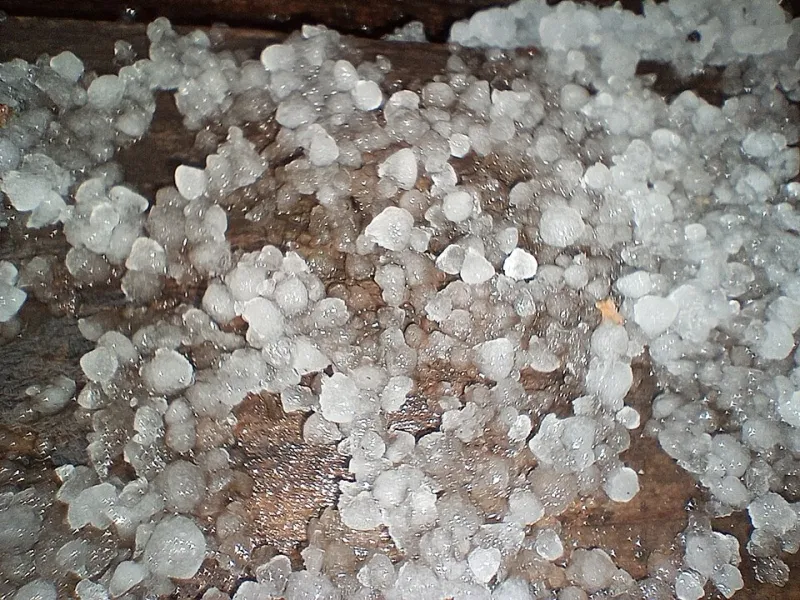
Photo: Natalka Ukraine, CC BY 4.0, via Wikimedia Commons
The Storm That Didn't Have to Happen
Most hailstorms are nobody's fault. They build, they hit, they move on, and farmers file insurance claims and try again next season. But the storm that rolled across a stretch of North Dakota farmland in the summer of 1962 was different. This one had been manufactured.
 Photo: North Dakota, via cdn.britannica.com
A cloud-seeding operation — the kind that had been proliferating across the American West and Midwest since the late 1940s — had been working the skies over the region, injecting silver iodide into cloud formations to trigger precipitation. The goal was usually to boost rainfall for drought-stressed crops. What happened instead, at least according to one farmer's account, was a concentrated hailstorm that tore through his fields and wiped out his harvest.
He didn't just complain about it. He hired a lawyer.
What followed was one of the stranger courtroom dramas in American agricultural history — a case that forced a jury of ordinary citizens to grapple with questions that philosophers and atmospheric scientists hadn't fully resolved: Can you own weather? Can you be responsible for it? And if a company deliberately reaches into the sky and pulls something down, who gets the bill when it goes wrong?
Cloud Seeding: The Part That Actually Works
Before getting to the courtroom, it's worth understanding what cloud seeding actually is — because it sounds like science fiction and isn't.
The basic concept was developed in the 1940s by researchers at General Electric, who discovered that introducing silver iodide particles into supercooled clouds could trigger ice crystal formation, which could lead to precipitation. In plain English: you could, under the right atmospheric conditions, encourage a cloud to rain. Or snow. Or, as it turned out, occasionally hail.
 Photo: General Electric, via www.marketbeat.com
By the early 1950s, cloud-seeding operations had become a genuine industry. Western states hired private weather-modification companies to coax rain out of drought skies. Farmers, municipalities, and ski resorts all became customers. The technology worked often enough to be commercially viable, but the atmosphere being what it is — chaotic, interconnected, indifferent to property lines — the results weren't always what anyone intended.
Hail is essentially precipitation that freezes before it reaches the ground. The same process that can be nudged to produce rain can, under different temperature conditions, produce ice. A cloud-seeding operation targeting one area could influence weather patterns downwind in ways that were difficult to predict and nearly impossible to control.
This is where the farmer's argument began.
The Courtroom Argument Nobody Had Made Before
The lawsuit itself was straightforward in structure and bizarre in substance. The farmer argued that the cloud-seeding company had deliberately intervened in natural atmospheric processes, that the intervention had directly caused the hailstorm, and that the resulting crop damage was the company's legal liability.
The defense had what seemed like an obvious counter: weather is an act of nature. You can't sue nature. The company had seeded clouds, yes, but the hail was the atmosphere doing what the atmosphere does. Drawing a straight legal line from a silver iodide dispenser to a flattened wheat field required a level of causation that most legal scholars at the time would have considered unprovable.
The farmer's legal team went after that assumption directly. They brought in meteorological testimony about the seeding operation's timing and location relative to the storm's development. They argued that the company's intervention had materially altered what would have occurred naturally — that without the seeding, the storm either wouldn't have formed or wouldn't have produced hail at that intensity.
The jury, composed of people who understood farming and weather in the visceral way that only comes from depending on both for your livelihood, found that argument persuasive. They awarded the farmer damages.
It was a verdict that stunned the weather-modification industry.
Who Owns the Sky? (Legally Speaking)
The philosophical question underneath all of this is one that American law had never really had to answer before the cloud-seeding era: what property rights, if any, extend upward?
Traditional property law gave landowners rights to the airspace above their land — that's why early aviation law was such a mess, and why the federal government eventually had to assert control over navigable airspace. But weather was different. Nobody had ever seriously argued that the clouds drifting over your farm belonged to you. They didn't stay. They moved. They were shared.
Cloud seeding complicated this. If a company could reach into shared atmospheric commons and deliberately alter them — pulling moisture out of clouds that might have rained on your neighbor's land instead, or triggering a storm that damaged your crops — then the question of liability became genuinely murky.
The 1962 verdict didn't fully resolve that murkiness. It didn't establish sweeping legal precedent in the way that landmark Supreme Court cases do. But it created a legal data point that courts and legislators couldn't ignore: juries were willing to hold weather modifiers liable for damage caused by their interventions.
The Quiet Ripple Effect
In the decades following the verdict, several states began enacting weather-modification licensing laws — requirements that companies conducting cloud-seeding operations notify local authorities, file operational plans, and carry liability coverage. North Dakota itself became one of the more active states in regulating the practice, in no small part because its agricultural economy made the stakes so concrete.
The cloud-seeding industry didn't collapse. It adapted. Operators became more careful about documentation, more cautious about operating near areas where crop damage claims might arise, and more attentive to the question of what exactly they could be held responsible for.
The farmer's lawsuit is rarely mentioned in legal textbooks. It doesn't have the profile of a Supreme Court case or a landmark ruling. But it sits quietly in the history of American environmental and agricultural law as the moment someone successfully argued that you can, in fact, be sued for the weather — if you made it.
And somewhere in North Dakota, a jury of twelve people once looked at a hailstorm and decided that somebody owed somebody else for it. Which, when you think about it, is exactly the kind of thing that sounds completely made up.
It isn't.