Chicago Built a Secret Underground City and Forgot to Tell Anyone It Was Supposed to Be the Future
The City Beneath the City
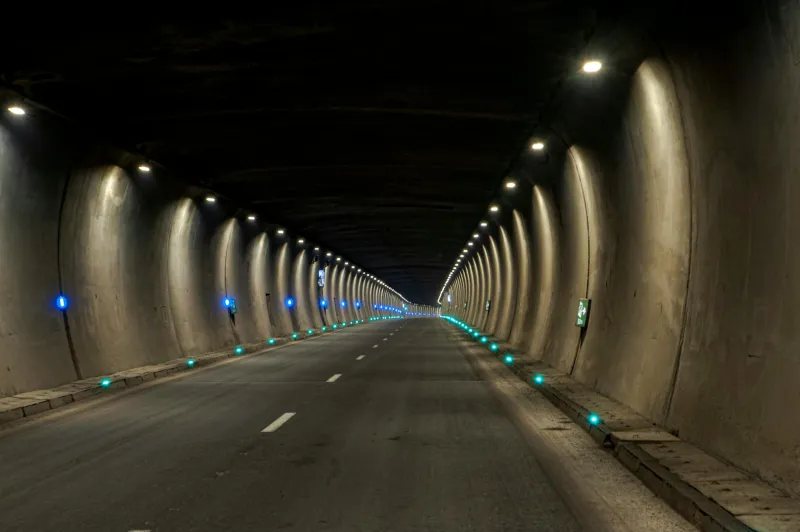
If you've ever driven through downtown Chicago and suddenly found yourself in what feels like the Batcave, you've experienced Lower Wacker Drive — a subterranean road system that exists in a permanent state of fluorescent-lit twilight beneath the regular streets.
Most visitors assume it's some kind of utilitarian afterthought, a place to hide delivery trucks and taxi storage. But Lower Wacker Drive represents something much stranger: the remnant of one of the most ambitious urban planning experiments in American history.
In the 1920s, Chicago engineers didn't just want to build an underground road. They wanted to revolutionize urban design by creating a multi-level city where different types of traffic operated on completely separate planes. Their vision was so radical that it makes today's smart city concepts look conservative.
The fact that they actually built part of it — and that it still works today — is either a testament to American engineering ambition or proof that we'll try anything once.
When Traffic Jams Drove People Underground
The story begins in 1923, when Chicago was experiencing the growing pains of automotive civilization. The city had been designed for horses and pedestrians, but suddenly everyone wanted to drive cars through the same narrow streets that had worked fine for centuries.
Traffic jams were becoming legendary. Downtown Chicago regularly experienced gridlock that lasted for hours, with streetcars, delivery wagons, automobiles, and pedestrians all competing for the same space. The situation was so bad that some businesses started scheduling meetings around traffic patterns.
Instead of accepting congestion as the price of progress, a group of city engineers led by Edward Bennett (co-author of the famous Burnham Plan) proposed something that sounded like science fiction: why not build a second city underneath the first one?
The Grand Vision of Vertical Traffic
Bennett's team didn't think small. Their "Chicago Plan of 1924" called for a comprehensive network of underground roadways that would separate different types of traffic into distinct layers.
The surface level would be reserved for pedestrians, retail, and light traffic. One level down would handle through traffic and commercial vehicles. A second sublevel would accommodate freight delivery and industrial transport. Some proposals even included a third level for utility infrastructure and a fourth for subway expansion.
The engineering drawings from 1924 look like something from a futuristic movie. Cross-sections show elegant underground boulevards lined with shops and restaurants, natural lighting systems that would bring sunlight to the lower levels, and sophisticated ventilation systems that would make underground driving pleasant rather than claustrophobic.
Most remarkably, they convinced city officials that this wasn't just possible — it was inevitable. "Every major city will eventually adopt multi-level design," Bennett wrote in 1925. "Chicago has the opportunity to lead this transformation."
Building the Future, One Block at a Time
Construction began in 1926 with the section of Lower Wacker Drive that still exists today. The engineering challenges were immense: they had to build roads underneath existing buildings while keeping the surface streets operational.
The solution was typically Chicago: they jacked up entire city blocks, built the underground road system, then lowered everything back down. For months, downtown Chicago looked like a construction site designed by M.C. Escher, with streets suspended in mid-air while workers built new streets underneath them.
The first phase was completed in 1930, creating a double-decked roadway along the Chicago River that handled both surface and underground traffic. The underground level was a revelation — smooth, well-lit, and surprisingly pleasant to drive through.
Local newspapers hailed it as proof that American engineering could solve any problem. "Chicago Builds the Street of Tomorrow," proclaimed the Tribune. "Traffic Jams Become Thing of the Past."
When the Future Met the Depression
Then the stock market crashed, and Chicago's underground city became a victim of economic reality.
The original plan called for expanding the underground road network throughout downtown Chicago, with connections to underground parking garages, shopping centers, and eventually residential areas. By 1932, funding had evaporated and the grand vision was reduced to maintenance of what had already been built.
Lower Wacker Drive survived, but as an isolated fragment rather than the foundation of a multi-level metropolis. What was supposed to be the beginning of Chicago's transformation into a vertical city became instead a curiosity — a single underground road that led nowhere in particular.
The Underground Road's Unexpected Second Life
For decades, Lower Wacker Drive existed in a kind of urban limbo. It was useful for downtown traffic, but it felt disconnected from the rest of the city. Cab drivers used it as a shortcut. Delivery trucks appreciated the loading docks. But mostly, it was just there — a reminder of a future that never quite materialized.
Then Hollywood discovered it.
Lower Wacker Drive's combination of dramatic lighting, urban decay, and futuristic architecture made it perfect for movie chase scenes. It has appeared in everything from "The Blues Brothers" to "The Dark Knight," usually standing in for some version of dystopian urban landscape.
The irony is perfect: Chicago's attempt to build the city of tomorrow became famous as a backdrop for fictional cities of the future.
Why We Keep Rediscovering the Same Ideas
What makes the Lower Wacker Drive story so fascinating is how it reveals the cyclical nature of urban planning. Every few decades, American cities rediscover the same "revolutionary" ideas: separate traffic levels, underground commercial districts, multi-use infrastructure.
Today's proposals for underground delivery networks, elevated bike paths, and multi-level parking systems are essentially updated versions of what Chicago engineers were proposing in the 1920s. We keep reinventing vertical urbanism because the fundamental problems — limited space, competing uses, traffic congestion — never really go away.
The difference is that Chicago actually built their version, which means we can see what happens when ambitious urban planning meets practical reality.
The Accidental Success of Incomplete Ambition
Lower Wacker Drive today is both a failure and a success. It failed to transform Chicago into a multi-level metropolis, but it succeeded in creating something unique: an underground road system that actually works.
Thousands of drivers use it daily without thinking about its origins. It reduces surface congestion, provides weather-protected driving during Chicago winters, and creates a genuinely useful piece of urban infrastructure.
Most importantly, it proves that sometimes the best urban planning happens when grand visions get scaled back to practical reality. Chicago's engineers dreamed of building a city of the future. Instead, they built something more valuable: a city feature that actually improves daily life.
The next time you find yourself driving through Lower Wacker Drive's fluorescent-lit tunnels, remember that you're experiencing a fragment of someone's utopian vision — a reminder that the most lasting urban innovations often come from dreams that were too big to fully realize but too useful to completely abandon.