The Rainmaker Who Drowned San Diego: When Weather Control Went Horribly Right
The Man Who Promised Rain
Charles Mallory Hatfield looked like a snake oil salesman, talked like a scientist, and claimed he could make it rain on command. In the drought-stricken winter of 1915, that was exactly what San Diego wanted to hear.
For five years, Southern California had been baking under relentless sunshine. Reservoirs sat empty, crops withered, and the city's 40,000 residents were rationing water like it was liquid gold. Traditional solutions — prayer, rain dances, and angry letters to the weather bureau — had failed spectacularly. So when Hatfield arrived in town claiming he could "accelerate precipitation through scientific atmospheric manipulation," desperate city officials decided to take a chance on the impossible.
What they got was a masterclass in being careful what you wish for.
The Science of Atmospheric Manipulation
Hatfield's credentials were, to put it charitably, unconventional. A former sewing machine salesman from Kansas, he claimed to have discovered the secret of weather control through years of "chemical atmospheric research" — which mostly involved mixing various compounds on top of tall towers and waiting to see what happened.
His method was a closely guarded trade secret, but witnesses reported seeing him climb a 20-foot wooden platform outside the city limits, where he would spend hours mixing mysterious chemicals in large vats. The resulting vapors, according to Hatfield, would "create nucleation points for atmospheric moisture condensation" — or in layman's terms, make clouds form and dump their contents on San Diego.
The scientific community was skeptical, but San Diego's City Council was desperate. On December 13, 1915, they signed what might be the strangest municipal contract in American history: Charles Hatfield would receive $10,000 (roughly $300,000 today) if he could deliver 40 inches of rain to the city's reservoirs by the end of the year.
Hatfield guaranteed results. "Gentlemen," he told the council, "prepare your reservoirs."
When the Heavens Opened
Hatfield began his atmospheric manipulation on January 1, 1916, climbing his tower with several assistants and enough chemical supplies to stock a small laboratory. For four days, nothing happened. San Diego's newspapers began running skeptical editorials about the city's "expensive rainmaker," and betting pools opened on whether Hatfield would produce so much as a drizzle.
Then, on January 5, the clouds began to gather.
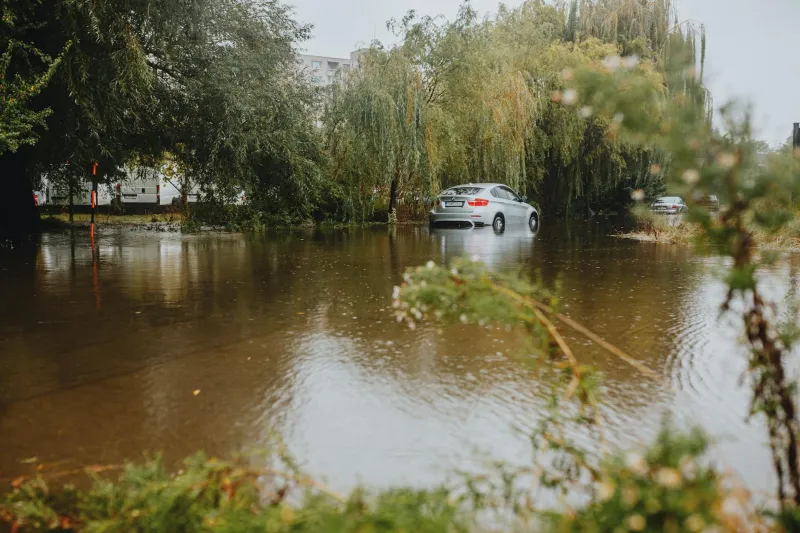
What started as a gentle drizzle quickly escalated into something that meteorologists would later describe as "meteorologically unprecedented." For the next three weeks, it rained with the intensity of a biblical plague. Not the gentle, reservoir-filling precipitation San Diego had hoped for, but torrential downpours that turned streets into rivers and hills into mudslides.
By January 20, the city had received more rain than it typically saw in three years. By January 27, the flooding had killed 22 people, washed out every bridge in the county, and cut off all rail and telegraph connections to the outside world. San Diego had become an island, surrounded not by ocean but by an endless deluge that showed no signs of stopping.
The Rainmaker's Dilemma
As the flood waters rose, Charles Hatfield faced an increasingly uncomfortable question: had his atmospheric manipulation actually worked, or was he just the luckiest charlatan in weather history?
The rain continued with such relentless intensity that even Hatfield seemed surprised. Witnesses reported seeing him on his tower, frantically adjusting his chemical mixtures and shouting instructions to his assistants over the roar of the storm. Whether he was trying to increase the rainfall or stop it entirely became a matter of considerable debate.
Meanwhile, San Diego's city officials found themselves in an impossible position. The contract clearly stated that Hatfield would be paid if he delivered 40 inches of rain — and he had delivered over 80 inches. But acknowledging that they had hired him would make the city legally responsible for every death, every destroyed building, and every washed-out bridge in the county.
The solution they chose was as elegant as it was dishonest: they simply pretended Charles Hatfield didn't exist.
The Great Denial
When the rains finally stopped in early February, San Diego looked like a war zone. The flood had caused over $3.5 million in damage (roughly $100 million today), destroyed 110 bridges, and left thousands of residents homeless. The city's response to this disaster was to announce that the recent weather had been "an act of God" and that any claims about artificial rain production were "scientifically impossible."
Charles Hatfield, standing in the ruins of what had once been a thriving city, demanded his $10,000 payment. After all, he had delivered exactly what the contract specified — and then some. City officials responded by claiming they had never heard of Charles Hatfield and suggesting he take up his payment dispute with the Almighty.
The ensuing legal battle lasted for years and produced some of the most surreal court testimony in California history. Hatfield's lawyers argued that their client had successfully performed weather control and deserved compensation. The city's lawyers countered that weather control was impossible, therefore Hatfield couldn't have caused the rain, therefore the city owed him nothing.
Both sides presented meteorological experts who offered completely contradictory explanations for the January floods. The case ultimately ended without resolution when Hatfield ran out of money for legal fees and the city ran out of patience for the entire bizarre situation.
The Science of Coincidence
Modern meteorologists studying the 1916 San Diego flood have reached a frustrating conclusion: it's impossible to determine whether Charles Hatfield actually influenced the weather or simply got incredibly lucky with his timing.
The atmospheric conditions that winter were certainly unusual. A series of Pacific storms had created exactly the kind of meteorological setup that could produce intense rainfall — with or without chemical manipulation. Hatfield's tower was positioned in an area where natural air currents might have enhanced any atmospheric effects his chemicals produced. Or the whole thing could have been an elaborate coincidence.
What's certain is that Hatfield's "atmospheric manipulation" involved real chemistry. Analysis of soil samples from his tower site revealed traces of silver iodide, calcium chloride, and other compounds that are now used in legitimate cloud seeding operations. Whether he had stumbled onto actual weather modification techniques or was just mixing impressive-looking chemicals remains an open question.
The Legacy of Artificial Rain
Charles Hatfield never received his $10,000, but he did achieve a different kind of success. The 1916 San Diego flood became a cautionary tale that influenced early discussions about weather modification research. When the U.S. government began serious cloud seeding experiments in the 1940s, scientists specifically cited the Hatfield case as an example of why weather control needed proper oversight.
San Diego, meanwhile, learned to be more careful about what it wished for. The city never again hired anyone claiming to control the weather, though it did invest heavily in flood control infrastructure. The reservoirs that Hatfield was supposed to fill were eventually replaced with a more reliable water system that didn't depend on atmospheric manipulation.
Today, a small historical marker near San Diego's Morena Dam commemorates the "Great Flood of 1916," though it makes no mention of Charles Hatfield or his mysterious chemical mixtures. The city apparently decided that some stories are better left untold — especially when they involve paying people to control the weather.
But the question remains: in January 1916, did San Diego experience a freak natural disaster, or did a sewing machine salesman from Kansas actually make it rain? The answer might be both, neither, or something in between. In a world where cloud seeding is now routine science, Charles Hatfield's story seems less impossible and more like a man who was either a pioneer or a fraud — and possibly both at the same time.
After all, the best way to never pay a rainmaker is to pretend it never rained.