The Mistake That Made History
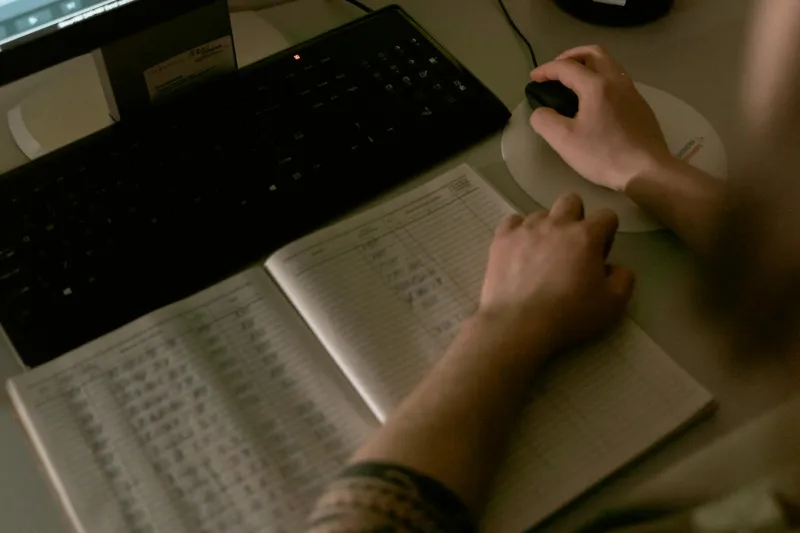
In the basement of the Federal Building in Chicago, census clerk Martha Kowalski was having a very long day. It was October 1891, and she was one of dozens of workers tasked with transferring handwritten census data from the previous year's count into standardized ledgers for final tabulation.
The work was mind-numbing: copying names, ages, occupations, and ethnic classifications from field reports into neat columns that would eventually become the official 1890 Census. After eight hours of squinting at messy handwriting, even the most careful clerk was bound to make mistakes.
Kowalski's error was tiny but consequential. When she encountered a field report listing several families as "Moravian" — referring to members of the Moravian Church, a Protestant denomination with roots in Central Europe — her tired fingers typed "Morovian" instead.
That single misplaced letter was about to create an entirely new American ethnicity.
How One Typo Became Official
The 1890 Census was the first to use Herman Hollerith's revolutionary tabulating machines, mechanical predecessors to modern computers that sorted data using punched cards. The system was designed to catch mathematical errors but had no way to identify fictional ethnic categories.
When Kowalski's "Morovian" entry was processed, the tabulating machine dutifully created a new classification code and began sorting all subsequent "Morovian" entries under this invented category. Field supervisors, assuming the classification was legitimate, began using it for anyone whose ethnicity seemed unclear or ambiguous.
By the time the final tallies were complete, the 1890 Census officially recorded 52,347 "Morovian" Americans scattered across seventeen states, with the largest concentrations in Pennsylvania, Ohio, and Illinois.
The Academic Echo Chamber
The Census Bureau published its findings in 1892, and "Morovians" immediately caught the attention of researchers studying American immigration patterns. Dr. Heinrich Zimmerman, a sociology professor at the University of Pennsylvania, devoted an entire chapter of his 1893 book "The New Americans" to analyzing Morovian settlement patterns.
Zimmerman theorized that Morovians were likely refugees from the Austro-Hungarian Empire, possibly from a region called "Morovia" that he couldn't locate on any map but assumed existed somewhere in the Carpathian Mountains. His work was cited by other academics, creating a scholarly consensus around a completely fictional ethnic group.
The invented Morovians even made it into congressional hearings. During 1894 debates over immigration restrictions, Representative William McKinley of Ohio cited "the rapid increase in Morovian settlement in industrial regions" as evidence that American cities were struggling to absorb new immigrant populations.
Nobody bothered to fact-check the existence of Morovia itself.
The Real People Behind the Fiction
Meanwhile, the 52,347 Americans officially classified as "Morovian" were living their lives completely unaware of their fictional ethnic status. Most were actually Moravians — members of the religious community founded in 15th-century Bohemia — while others were immigrants from various Central European regions whose ethnicity had been unclear to census takers.
The Moravian Church itself tried to correct the error in 1895, sending a letter to the Census Bureau explaining that "Moravian" referred to religious affiliation, not ethnicity, and that "Morovian" wasn't a real word. The letter was filed away and apparently ignored.
Some immigrant families actually embraced their new "Morovian" identity. In Cleveland, a group of Czech and Slovak immigrants began calling themselves the Morovian-American Cultural Society, not realizing they were celebrating a clerical error.
When Reality Caught Up
The fiction began unraveling during preparation for the 1900 Census. New supervisor James Merriam was reviewing the previous decade's classifications when he noticed something odd about the Morovian category.
"I couldn't find any reference to a place called Morovia in any atlas," Merriam later wrote in his memoirs. "When I asked my predecessor about it, he just shrugged and said it had come from the tabulating machines."
Merriam's investigation revealed the original typo and traced its path through a decade of official documents. The discovery was embarrassing enough that the Census Bureau quietly dropped the Morovian classification from the 1900 count without any public announcement.
The 52,347 former "Morovians" were reclassified based on their actual countries of origin, and the invented ethnicity disappeared from federal records as quietly as it had appeared.
The Papers That Lived On
But academic literature moves slowly. Dr. Zimmerman's theories about Morovian settlement patterns continued to be cited in sociology papers well into the 1900s. A 1908 dissertation at Columbia University included an entire section on "Morovian economic adaptation strategies" based on Zimmerman's fictional research.
The last known academic reference to Morovians appeared in a 1911 comparative study of European immigrant groups, which noted that "Morovian communities appear to have assimilated rapidly into American society, as evidenced by their absence from recent census data."
The author concluded that this rapid assimilation made Morovians "a model immigrant group" — apparently unaware that their success was due to never having existed in the first place.
The Legacy of a Typo
The Morovian incident led to significant changes in census procedures. The 1900 Census included extensive quality control measures, with supervisors required to verify unfamiliar ethnic classifications before final tabulation. Similar safeguards were built into Hollerith's improved tabulating machines.
Martha Kowalski, the clerk whose typo started it all, never learned about the consequences of her mistake. She left the Census Bureau in 1892 to get married and died in 1934, decades before historians uncovered the story of America's most successful fictional ethnic group.
The Question That Remains
Today, genealogists occasionally encounter 1890s documents referencing "Morovian" ancestry and wonder what it means. The answer is both simple and profound: it means that for nearly a decade, the United States government's understanding of its own population was shaped by a single tired clerk's typing error.
In an age when we worry about data accuracy and algorithmic bias, the Morovian incident serves as a reminder that human error has always been part of how we count ourselves — and that sometimes our mistakes can take on a life of their own.